SUP paddling tips for better straight paddling


By Rahul Bansal
2 min read

SUP Paddel-Tipps zum besseren Geradeaus-Paddeln

Tips for better straight paddling

The best carbon paddle and the highest quality boards are only half as fun if you don't master the technique and can't paddle straight with your SUP.
We believe that good equipment and accessories are a foundation for long-term fun on the water. However, mastering the correct paddling technique is at least as important.

Learn how to paddle properly on the GTS touring board. Fully submerge the paddle blade to ensure smooth forward travel on your paddleboard.

With the right technique, not only can you glide away with less effort and be more fun, but you'll also protect your body. The shoulder and elbow joints, in particular, can become painful if the wrong strain is applied, seriously spoiling your fun on the water.
That’s why today we’ve brought you some technical tips for paddling straight ahead:

  • Make sure that you are standing correctly on the board. Depending on the load, approximately The middle of the board , which is usually at the height of the carrying handle, should be about hip-width apart. Increase your stance if you feel a bit wobbly or want to apply more pressure to the outer edges of the board.
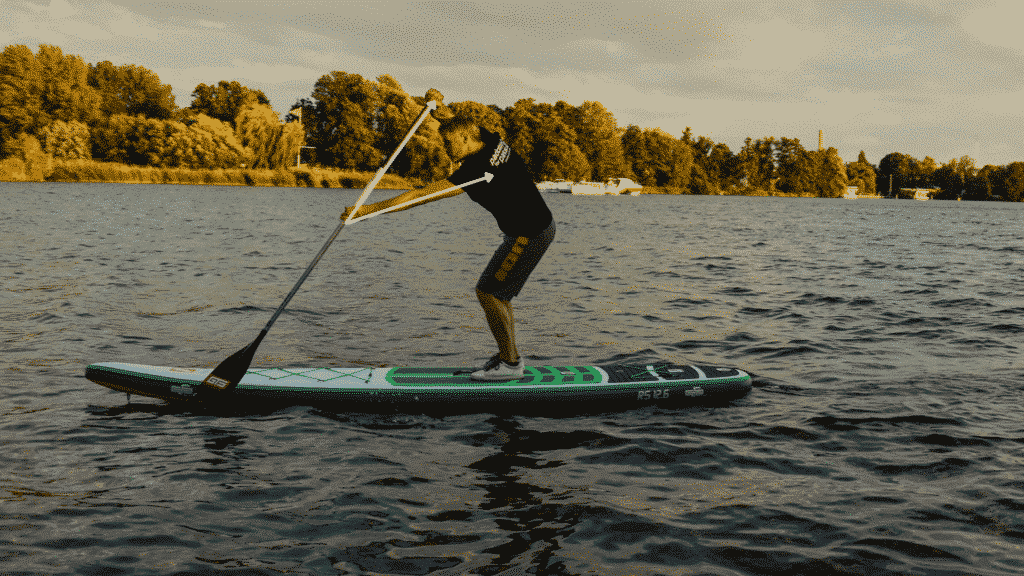
  • Grip the paddle far enough apart with your hands. This corresponds to approximately one Your arms should now form an isosceles triangle with the paddle . When changing sides of the paddle, make sure you grip the same spot where your lower hand is. In any case, the distance between your hands should not decrease when you change sides.
Form a paddle triangle to enable better straight paddling with the SUP
An arm's length distance between the hands.
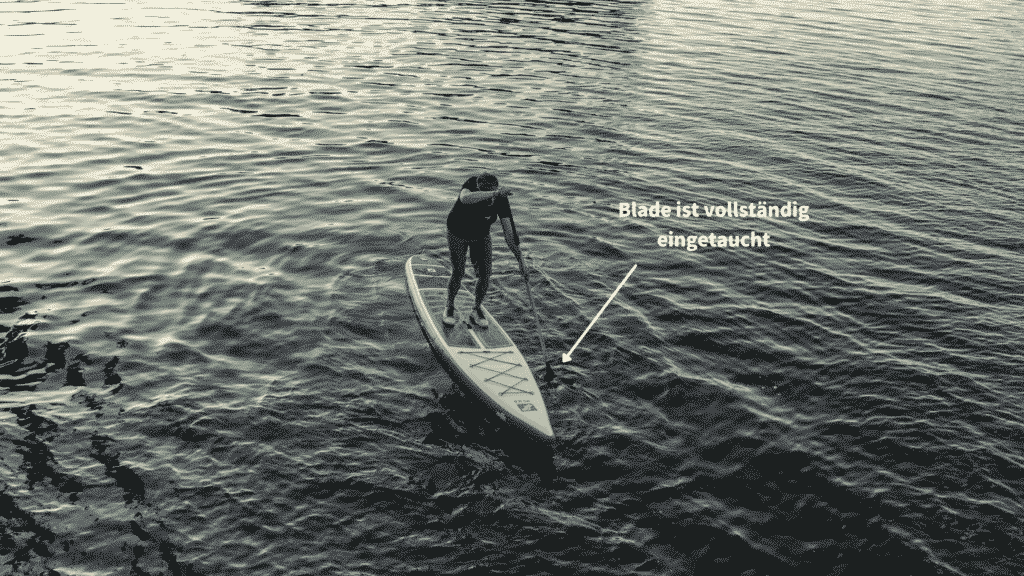
  • Completely submerge the paddle blade . This is one of the most common mistakes. Make sure the blade is completely submerged and no part of the paddle blade protrudes above the water.
Learn how to paddle properly on the GTS touring board. Fully submerge the paddle blade to ensure smooth forward travel on your paddleboard.
  • Now pull the paddle as close as possible to the board rail, parallel to your body. Imagine you're tracing the outside of the board with your paddle. Of course, you shouldn't touch the sidewall (rail), but the closer you are to the board, the better.
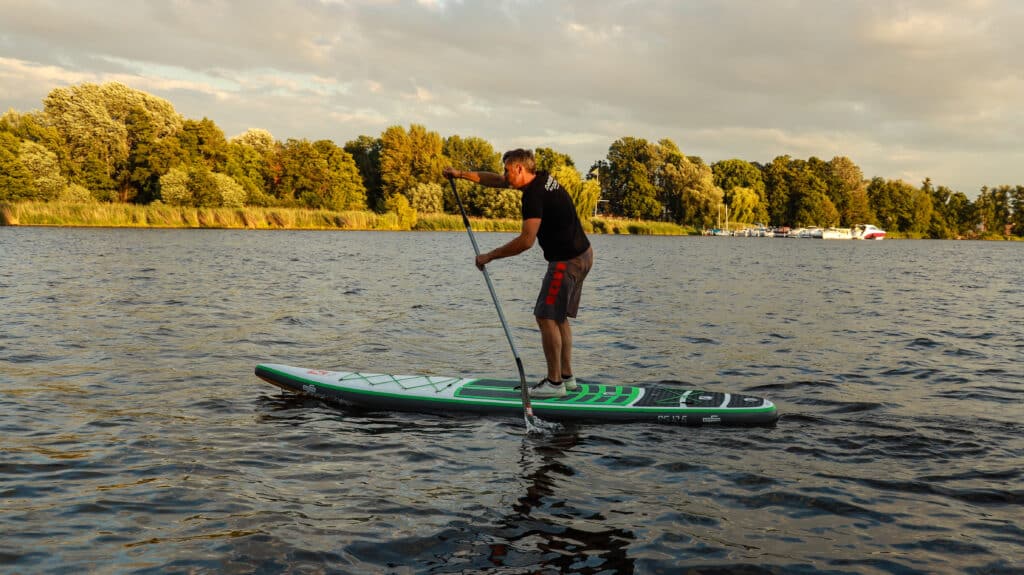
  • The Paddle stroke when stand up paddling preferably in front of the body take place. From where you are standing, pull the paddle blade out of the water again. This is only a guideline. The faster you want to go, or in conditions such as headwinds or a headcurrent, you can save valuable energy by pulling the paddle out of the water at body height.

· The Shape of the board influences of course also the straight-line running while paddling. A round All-rounder – Shape is more flexible when changing direction, as is necessary when surfing with a wing or sail. Therefore, straight-line stability is rather limited. We recommend a Touring board with a very straight outer line and a board tip for a clean, straight run. The length of the board can also be crucial. Choose a board that's about twice as long as you are tall.

Learn how to paddle properly on the GTS touring board. Fully submerge the paddle blade to ensure smooth forward travel on your paddleboard.
Pull the paddle out of the water at foot level.
All-rounder and touring SUP board from the GTS SUP shop in Berlin. Also pictured is a GTS carbon paddle.
All-rounder vs. Touring Shape

Extra tip:

The larger the fin, the better the board's straight-line stability.

We definitely recommend taking a technical course at a SUP school of your choice.